Media filtering is usually implemented as a feature inside a particular player. OpenFilter Lab asks what changes when the filter becomes a portable artifact the viewer can inspect, edit, share, and carry between compatible tools.
The project takes the form of a proposed .of.json sidecar format describing how media was matched, timestamped events, categories, severity, actions, provenance, and review state. Its purpose is to let people own transparent media filters that can move between tools instead of being locked inside a platform.
The question behind OpenFilter Lab
The proposed .of.json sidecar records how a media file was matched, which timestamped events were identified, what categories and severity were assigned, what action is requested, and whether the annotation came from a person or an unreviewed model draft. Viewers, parents, accessibility users, media-tool developers, and communities with specific content preferences may benefit. Creators and rights holders are affected by derivative annotations.
How OpenFilter Lab took shape
The laboratory workflow uses ffprobe and ffmpeg, an optional classifier, human review, and a local player capable of consuming mute and skip events. The classifier is intentionally not the final authority; its useful output is a draft that preserves provenance and can be corrected. I developed the portable-filter idea, local-first values, human-review rule, and product direction, then directed agent-assisted prototyping.
Working output · synthetic validation reel
A portable filter remains inspectable at playback time.
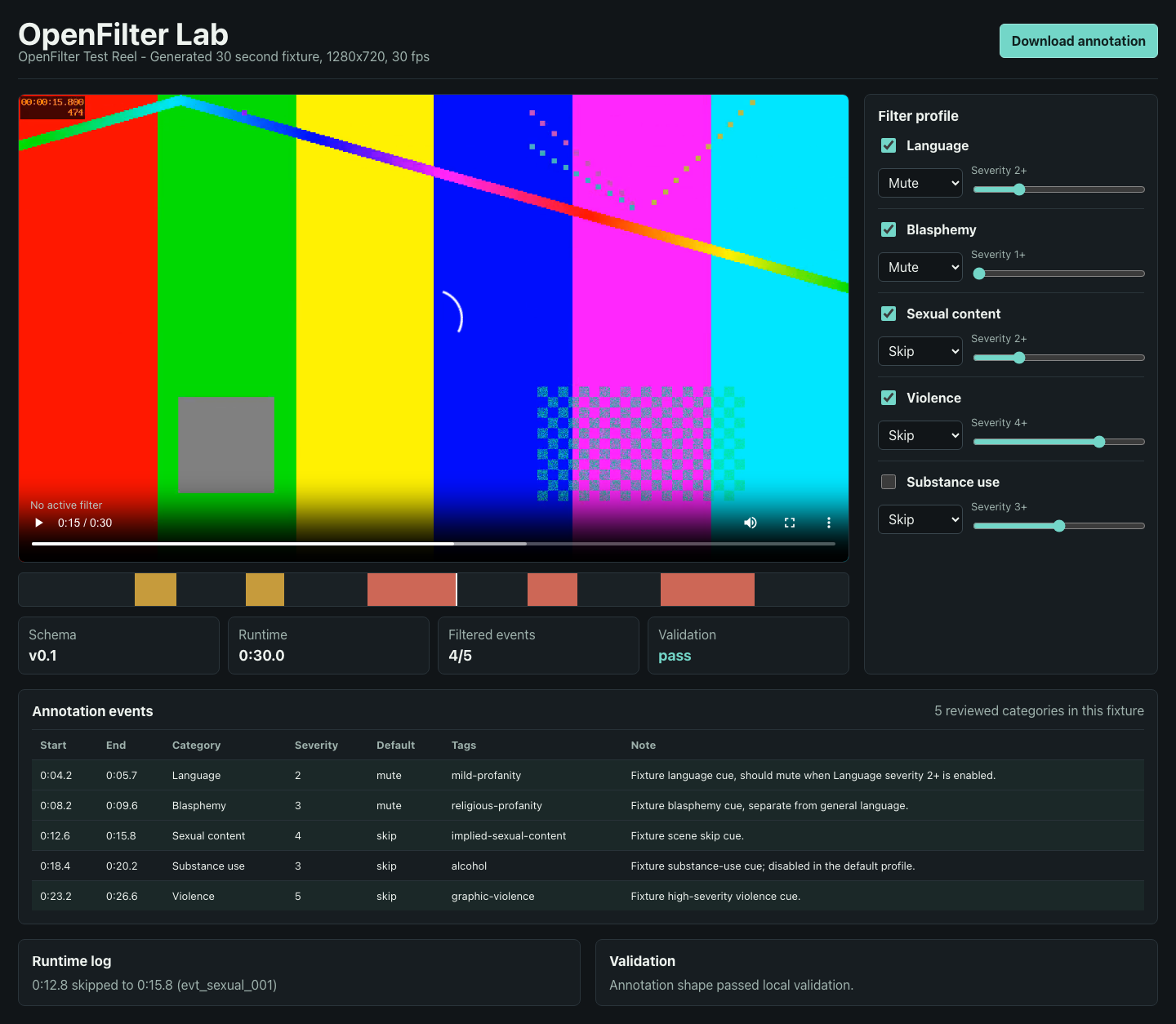
The local player applies mute and skip rules to a synthetic fixture while exposing every timestamped annotation and validation result. No copyrighted film footage is used in this demonstration.
Source: OpenFilter Lab player fixture · July 2026What the evidence supports
A functioning laboratory repository and player workflow exist, but there is no broad ecosystem adoption or mature classifier. The larger idea is user-owned media policy without bypassing access controls. Interoperability could make household preferences durable, but copyright, DRM, matching reliability, and annotation rights define hard boundaries for any public ecosystem.
Copyright, DRM, platform terms, matching reliability, and annotation quality constrain deployment. The project does not bypass access controls. Future work centers on stabilizing the sidecar specification, releasing original test fixtures, and demonstrating interoperability between two independent consumers.